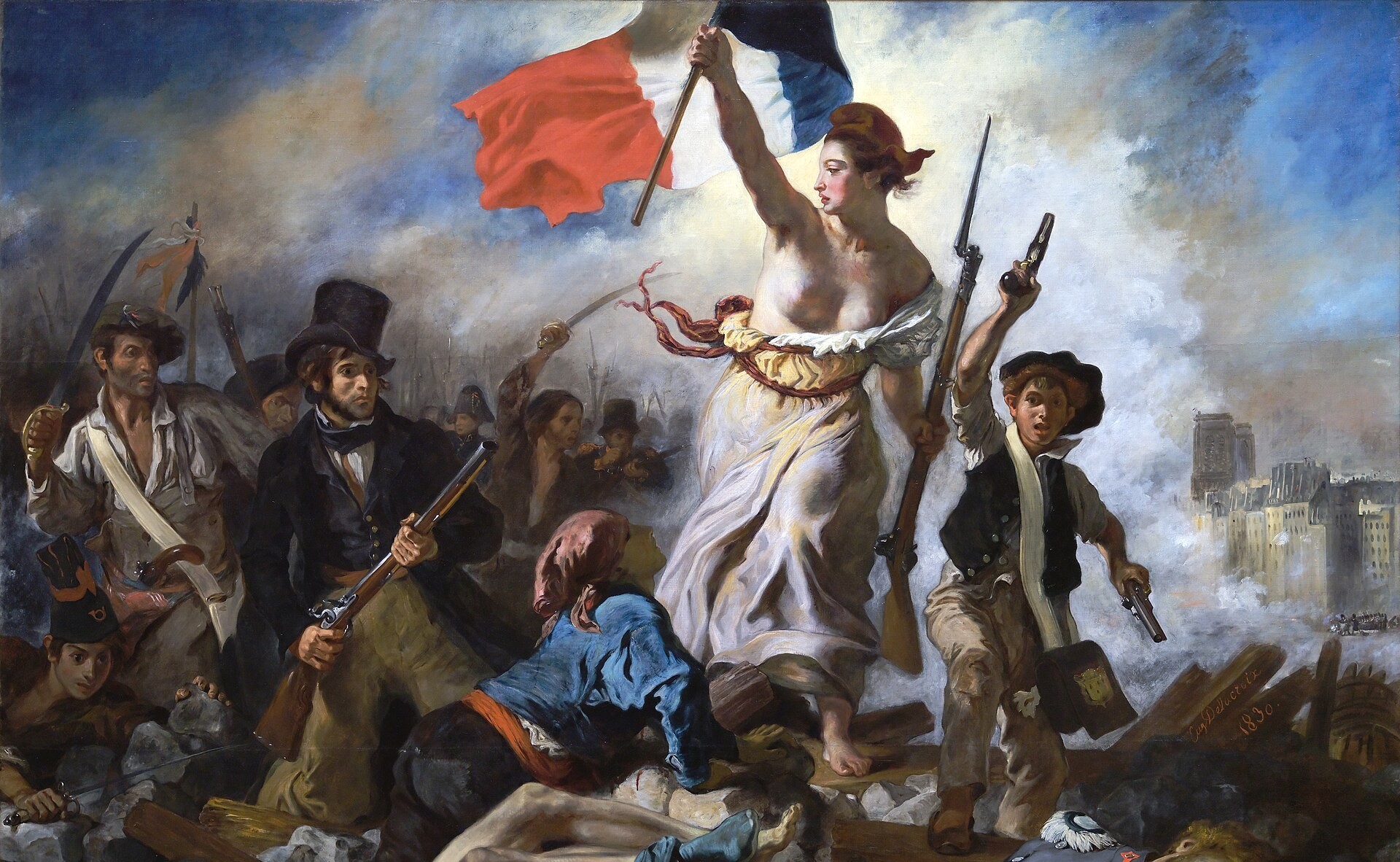
1789年7月14日,巴黎街頭。一個麵包師傅的妻子瑪麗.安妮從清晨就站在市場外頭,等待那輛每天早上都會來的麵包車。那天,車沒有來。她知道原因——小麥歉收、糧食囤積、物價飛漲,窮人家裡的麵包早就吃完了。
On July 14, 1789, on the streets of Paris, a baker's wife named Marie Anne stood outside the market since early morning, waiting for the bread cart that came every day. That day, it did not come. She knew why — a poor harvest, hoarded grain, prices too high for the poor to pay.
她的三個孩子從昨天起就沒有進食。她走回家,看了看孩子,又走出門,這一次,她沒有去市場,而是跟著街上越來越多的人群,朝著同一個方向走去。
The bread in her house had run out long ago. Her three children had not eaten since the day before. She walked home, looked at her children, and walked back out again. This time, she did not go to the market. She followed the growing crowd in the street, all moving in the same direction.
那個方向,是巴士底監獄。那天下午,那座象徵王權暴政的監獄被憤怒的群眾攻破了。瑪麗.安妮後來對女兒說,她那天不是為了自由或平等才去的,她只是太餓了,餓到連怕死都顧不上。但歷史記住的,是那一天:法國大革命,開始了。
That direction was the Bastille prison. That afternoon, the fortress that symbolized royal tyranny was stormed by furious crowds. Marie Anne later told her daughter that she hadn't gone that day for freedom or equality — she had simply been too hungry to be afraid of dying. But what history remembers is that day: the French Revolution had begun.
什麼是法國大革命?/What Is the French Revolution?
「法國大革命」(The French Revolution)是指從1789年延續至1799年,發生在法國的一場根本性政治與社會變革。在這十年間,延續了將近一千年的法國君主制度被推翻,國王路易十六與王后瑪麗·安東尼雙雙被送上斷頭台,封建制度遭到廢除,「自由、平等、博愛」(Liberté, Égalité, Fraternité)成為一個新時代的宣言。
The French Revolution refers to a fundamental political and social transformation that took place in France from 1789 to 1799. During these ten years, the French monarchy — which had lasted for nearly a thousand years — was overthrown. King Louis XVI and Queen Marie Antoinette were both sent to the guillotine. The feudal system was abolished, and "Liberty, Equality, Fraternity" became the declaration of a new age.
法國大革命是啟蒙運動思想最直接、也最暴烈的政治爆發。洛克說人民有權推翻侵犯自然權利的政府;盧梭說政府的合法性來自人民的「公意」;孟德斯鳩說權力必須受到制衡——這些在書桌前寫下的哲學,在1789年的巴黎街頭,變成了真實的行動。然而,革命的結局遠比任何哲學家所預想的更加複雜、更加血腥,也更加令人深思。
The French Revolution was the most direct — and most violent — political explosion of Enlightenment thought. Locke had written that people have the right to overthrow governments that violate their natural rights. Rousseau had argued that the legitimacy of government comes from the "general will" of the people. Montesquieu had insisted that power must be checked and balanced. These ideas, written at desks and in studies, became real action on the streets of Paris in 1789. But the outcome of the Revolution was far more complex, far bloodier, and far more thought-provoking than any philosopher had imagined.
大革命前的法國——即將爆炸的社會/A Society About to Explode
1788年的冬天是法國近百年來最寒冷的一個冬天。塞納河結冰了,運河停航了,農田裡的莊稼全部凍死。一個叫做雅克的農民坐在他那間漏風的茅屋裡,算了又算:他今年的收成裡,要交給地主四分之一,要交給教會十分之一的「什一稅」,要交給國王各種名目的稅,加在一起,他能留下來的,還不到自己收成的一半。
The winter of 1788 was the coldest France had seen in nearly a century. The Seine River froze, the canals stopped running, and the crops in the fields were all killed by frost. A farmer named Jacques sat in his drafty cottage and calculated again and again: from this year's harvest, he owed one quarter to his landlord, a tithe of one tenth to the Church, and various taxes to the king under different names. All together, what he could keep was less than half of what he had grown.
而他的家裡,還有六張等著吃飯的嘴。窗外的風把茅屋的牆壁吹得吱呀作響,他望著桌上那塊快要見底的麵包,想起神父上週在彌撒裡說的話:「忍耐是美德,上帝會獎賞謙遜的人。」雅克把那塊麵包分成六份,每人一份,然後閉上眼睛,沒有禱告,只是坐在那裡聽著風聲。他已經忍耐了三十年了。
And in his house, there were six mouths waiting to be fed. Outside, the wind rattled the walls of the cottage. He stared at the shrinking loaf of bread on the table and remembered what the priest had said at Mass the week before: "Patience is a virtue. God rewards the humble." Jacques divided the loaf into six pieces, one for each person, then closed his eyes — no prayer, just sitting there listening to the wind. He had been patient for thirty years.
要理解法國大革命為何爆發,必須先理解它爆發之前,法國社會的結構性矛盾。
To understand why the French Revolution broke out, we must first understand the structural contradictions of French society that existed before it.
18世紀末的法國,社會被分為「三個等級」(Three Estates)。第一等級是教士(clergy),約佔人口的0.5%,卻擁有全國約10%的土地,幾乎不需要繳稅。第二等級是貴族(nobility),約佔人口的1.5%,享有大量特權,同樣免於許多稅務。第三等級則涵蓋了其餘98%的人口,包括富裕的資產階級商人與律師、城市裡的工匠與工人,以及佔人口最大多數的農民。這98%的人,承擔了法國幾乎所有的賦稅。
In late 18th-century France, society was divided into three estates. The First Estate was the clergy, who made up about 0.5% of the population but owned roughly 10% of the nation's land and paid almost no taxes. The Second Estate was the nobility, about 1.5% of the population, who enjoyed extensive privileges and were also exempt from many taxes. The Third Estate included the remaining 98% of the population — wealthy bourgeois merchants and lawyers, urban craftsmen and workers, and the vast majority who were peasants. This 98% bore almost all of France's tax burden.
更雪上加霜的是,18世紀末的法國財政已瀕臨崩潰。法國支持美國獨立戰爭、長期與英國爭奪殖民地的代價,讓國庫嚴重虧空。國王路易十六(Louis XVI)的政府試圖向貴族徵稅以彌補赤字,卻遭到貴族強烈抵制。1788年的嚴冬與糧食歉收,則讓底層人民的憤怒完全沸騰——一般家庭要把將近80%至90%的收入用於購買麵包。
Making matters far worse, the French government's finances were close to total collapse by the late 18th century. The enormous cost of supporting the American Revolution and competing with Britain for colonies had left the treasury dangerously empty. King Louis XVI's government tried to tax the nobility to close the gap, but faced fierce resistance. Then the brutal winter of 1788 and a poor harvest pushed the anger of the lower classes to a full boil — ordinary families were spending as much as 80 to 90 percent of their income just on bread.
就在這個時候,啟蒙運動的思想透過書籍、小冊子與咖啡館的討論,已經深深滲入了法國資產階級的意識當中。那些受過教育的第三等級成員,清楚地知道洛克、盧梭與孟德斯鳩說過什麼。他們也清楚地看到,眼前的社會結構,與那些思想所主張的「自然平等」與「社會契約」,是多麼天壤之別。憤怒,終於找到了一套可以表達自己的語言。
At this very moment, Enlightenment ideas had already penetrated deeply into the consciousness of France's bourgeoisie through books, pamphlets, and coffeehouse discussions. The educated members of the Third Estate knew clearly what Locke, Rousseau, and Montesquieu had said. They could also see, just as clearly, how enormous the gap was between the existing social structure and the "natural equality" and "social contract" those thinkers had described. Anger had finally found a language in which to express itself.
法國大革命爆發——從三級會議到攻占巴士底/The Outbreak

(資料來源:Prise de la Bastille)
1789年5月,凡爾賽宮。一個來自第三等級的年輕律師米拉波(Mirabeau),走進了那個金碧輝煌的大廳,心裡充滿了憤怒,臉上卻保持著冷靜。
In May 1789, at the Palace of Versailles, a young lawyer from the Third Estate named Mirabeau walked into the glittering great hall, full of anger inside but calm on the surface.
三級會議召開了——這是法國將近一百七十五年來第一次召開這個議事機構。但就在開幕的第一天,第一、二等級的代表就為了一件事吵得不可開交:投票的方式。貴族和教士堅持每個等級投一票,讓他們兩票對一票永遠壓制第三等級;第三等級則要求按人頭計票。
The Estates-General had been convened — the first time this assembly had met in nearly one hundred and seventy-five years. But on the very first day, the representatives of the First and Second Estates were already arguing furiously about one thing: how to vote. The nobles and clergy insisted on one vote per estate, which would always give them a two-to-one majority over the Third Estate. The Third Estate demanded a vote by head count.
米拉波站起來,說了一句讓整個大廳鴉雀無聲的話:「我們是人民的代表,我們只能被刺刀趕走。」三個星期後,第三等級的代表宣布自己為「國民議會」,拒絕離開。路易十六下令封閉議事廳,他們就在附近的網球場宣誓:不制定出一部憲法,絕不解散。那一天,舊制度的裂縫,已經無法彌合了。
Mirabeau stood up and said something that silenced the entire hall: "We are the representatives of the people. Only bayonets can drive us away." Three weeks later, the representatives of the Third Estate declared themselves a National Assembly and refused to leave. When Louis XVI ordered the meeting hall locked, they gathered at a nearby tennis court and swore an oath: they would not disband until they had written a constitution. That day, the cracks in the old order could no longer be repaired.
1789年5月,國王路易十六在財政危機的壓力下,召開了三級會議(Estates-General),這是自1614年以來法國首次召開此類議事機構。第三等級的代表來到凡爾賽,帶著滿腔改革的期待,卻立刻遭遇了程序上的打壓。憤怒之下,第三等級的代表宣布自己組成「國民議會」(National Assembly),並在著名的「網球場宣誓」(Tennis Court Oath)中承諾,不制定出一部憲法就絕不解散。
In May 1789, under the pressure of a financial crisis, King Louis XVI convened the Estates-General — the first time France had called this assembly since 1614. Representatives of the Third Estate arrived at Versailles full of hopes for reform, only to immediately face procedural suppression. In anger, they declared themselves a National Assembly and, in the famous Tennis Court Oath, pledged not to disband until they had produced a constitution.
這是一個決定性的時刻:人民第一次公開宣稱,政府的權威來自人民,而非來自國王。
This was a decisive moment: for the first time, the people publicly declared that the authority of government came from the people, not from the king.
與此同時,巴黎城內的緊張局勢達到了頂點。謠言傳說國王正在調兵進京,準備鎮壓。1789年7月14日,憤怒的巴黎市民攻占了巴士底監獄(Bastille)——那座監獄裡只關了七個囚犯,但它是王權壓迫的象徵。巴士底監獄的陷落,成為法國大革命正式爆發的標誌性時刻,也是今天法國國慶日(七月十四日)的由來。
At the same time, tension inside Paris reached a breaking point. Rumors spread that the king was moving troops toward the city to crush the movement. On July 14, 1789, furious Parisian citizens stormed the Bastille prison — which held only seven prisoners at the time, but stood as a symbol of royal oppression. The fall of the Bastille became the defining moment of the French Revolution's outbreak, and is the origin of France's national holiday, celebrated every July 14th.
幾週後,農村各地的農民紛紛起義,衝進貴族的莊園,燒毀土地所有權的文件。這場被稱為「大恐慌」(Great Fear)的農民起義,迫使國民議會在1789年8月4日的夜晚通過了廢除封建制度的法令,一夜之間,千年的封建特權正式宣告終結。
Within weeks, peasants across the countryside rose up, storming noble estates and burning the documents that recorded their land obligations. This wave of rural uprisings, known as the Great Fear, forced the National Assembly to pass decrees abolishing the feudal system on the night of August 4, 1789. In a single night, a thousand years of feudal privilege was officially declared over.
法國大革命下催生之制度——《人權宣言》與立憲時期/The Declaration of the Rights of Man and the Constitutional Period

(資料來源:Tennis Court Oath, Jacques-Louis David)
1789年8月26日深夜,國民議會。一個議員在辯論了整整十三個小時之後,終於在文件上簽下了自己的名字。那份文件的第一條寫道:「在權利方面,人們生來是而且始終是自由平等的。」他停下來,把羽毛筆放回筆架,想起了十七歲時在父親的書架上偷偷翻到的那本盧梭的書,想起書頁邊緣他用鉛筆寫下的那些問號和驚嘆號。他沒想到,那些問號,有一天會變成一份真實的文件,印上法蘭西共和國的印章。他也沒想到,那份文件將在五年後幾乎殺死他——因為在恐怖統治的年代,今天的革命者,很可能就是明天的罪人。
On the night of August 26, 1789, in the National Assembly, a delegate signed his name on a document after thirteen straight hours of debate. The first article of that document read: "Men are born and remain free and equal in rights." He set down his quill and thought of the book by Rousseau he had secretly pulled from his father's bookshelf at seventeen — of the question marks and exclamation points he had penciled in the margins. He had not imagined that those question marks would one day become a real document, stamped with the seal of the French Republic. He also did not imagine that the same document would nearly get him killed five years later — because in the age of the Terror, today's revolutionary could very easily become tomorrow's criminal.
1789年8月,國民議會通過了《人與公民權利宣言》(Declaration of the Rights of Man and of the Citizen),這是法國大革命最重要的文件之一,也是人類歷史上最具影響力的人權文件之一。宣言開篇即宣稱:「在權利方面,人們生來是而且始終是自由平等的。」它確立了言論自由、宗教自由、財產權、法律面前人人平等,以及主權在民等核心原則。
In August 1789, the National Assembly passed the Declaration of the Rights of Man and of the Citizen, one of the most important documents of the French Revolution and one of the most influential human rights documents in history. Its opening declared: "Men are born and remain free and equal in rights." It established core principles including freedom of speech, freedom of religion, the right to property, equality before the law, and the idea that sovereignty belongs to the people.
這份宣言明顯受到美國《獨立宣言》與洛克、盧梭哲學的影響。然而,它也有一個重大的矛盾:宣言所宣稱的「人」,在當時主要指男性公民;女性的政治權利被完全排除在外。女性活動家奧蘭普·德·古日(Olympe de Gouges)為此撰寫了《女性與女公民權利宣言》(Declaration of the Rights of Woman and of the Female Citizen),要求將平等原則延伸至女性。她後來在恐怖統治時期被送上了斷頭台。
This declaration was clearly influenced by the American Declaration of Independence and the philosophies of Locke and Rousseau. However, it also contained a significant contradiction: the "men" the declaration referred to were primarily male citizens — women's political rights were entirely excluded. Female activist Olympe de Gouges responded by writing the Declaration of the Rights of Woman and of the Female Citizen, demanding that the principle of equality be extended to women. She was later sent to the guillotine during the Reign of Terror.
在《人權宣言》通過之後,法國進入了一段相對穩定的立憲時期。1791年,法國制定了第一部憲法,建立了君主立憲制度,確立了三權分立的基本架構。路易十六在理論上仍是國王,但權力大幅受限。這個安排本來可能成為一個溫和改革的起點,但路易十六在1791年秘密試圖逃往奧地利,尋求外國軍隊的支援來恢復王權,事跡敗露後,他徹底失去了人民的信任。革命的鐘擺,開始向更激進的方向擺動。
After the Declaration of the Rights of Man, France entered a relatively stable constitutional period. In 1791, France adopted its first constitution, establishing a constitutional monarchy and laying out a basic framework of separated powers. Louis XVI remained king in theory, but with greatly reduced authority. This arrangement might have become the starting point for moderate reform — but Louis XVI secretly attempted to flee to Austria in 1791 to seek foreign military support for restoring his power. When this was discovered, he completely lost the trust of the people. The pendulum of the Revolution began to swing toward a more radical direction.
法國大革命孕育恐怖統治/When the Revolution Devoured Its Own Children

(資料來源:Exécution de Louis XVI, Georg Heinrich Sieveking)
1793年10月,巴黎,斷頭台廣場。劊子手已經是今天第三次站在這裡了。人群中有人在叫好,有人沉默,有人轉過身去不敢看。一個賣栗子的老婦人低著頭,口中喃喃自語:「那個人昨天還是革命委員會的委員,今天就……」她沒說完。她的孫子拉了拉她的袖子,問:「奶奶,那個人是壞人嗎?」老婦人想了很久,才說:「他昨天不是。」沒有人知道明天會輪到誰。巴黎已經學會了一件事:在這個時代,最危險的地方,不是舊制度的牢獄,而是革命本身的核心。
In October 1793, at the Place de la Révolution in Paris, the executioner was standing there for the third time that day. In the crowd, some people cheered, some were silent, and some turned away and could not watch. An old woman selling chestnuts muttered quietly: "That man was still a member of the Revolutionary Committee yesterday, and today he's…" She didn't finish the sentence. Her grandson tugged at her sleeve and asked: "Grandmother, was that man a bad person?" The old woman thought for a long time before answering: "He wasn't, yesterday." No one knew whose turn would come tomorrow. Paris had learned one thing: in this era, the most dangerous place was not the prison of the old regime — it was the very heart of the Revolution itself.
1792年,法國與奧地利、普魯士開戰,外國軍隊逼近法國邊境,國內同時爆發了多處保王黨叛亂。在這種內外夾攻的危機之下,革命政府急速激進化。1792年9月,君主制被廢除,法蘭西第一共和國正式成立。1793年1月,路易十六被送上斷頭台,王后瑪麗·安東尼在同年10月亦遭處決。
In 1792, France went to war with Austria and Prussia, and foreign armies advanced toward French borders while royalist uprisings broke out across the country. In this crisis, with enemies both inside and outside, the revolutionary government radicalized rapidly. In September 1792, the monarchy was abolished and the First French Republic was officially established. In January 1793, Louis XVI was sent to the guillotine. Queen Marie Antoinette followed in October of the same year.
接下來,革命進入了它最黑暗的篇章:恐怖統治(the Reign of Terror,1793–1794年)。以馬克西米連·羅伯斯比爾(Maximilien Robespierre)為首的「公共安全委員會」(Committee of Public Safety)掌握了近乎獨裁的權力,以「保衛革命」為名,開始大規模清洗所有被認為是革命敵人的人——無論是真正的保王黨人、溫和派改革者,還是昔日的革命同志。
The Revolution then entered its darkest chapter: the Reign of Terror (1793–1794). The Committee of Public Safety, led by Maximilien Robespierre, seized near-dictatorial power and, in the name of "defending the Revolution," began a massive purge of anyone considered an enemy of the Revolution — whether actual royalists, moderate reformers, or former revolutionary comrades.
在短短約十六個月之內,估計約有一萬七千人被正式處決,另有數萬人死於監獄或未經正式審判的處決。斷頭台成為那個時代最恐怖的象徵。最諷刺的是,昨天的革命英雄,今天可能就成了革命的敵人——革命的創始者之一,丹頓(Georges Danton)也在1794年4月被送上了斷頭台,據說在最後一刻,他對劊子手說:「把我的頭拿去給人民看,這是值得一看的東西。」
In roughly sixteen months, an estimated seventeen thousand people were formally executed, and tens of thousands more died in prison or without trial. The guillotine became the most terrifying symbol of the age. Most ironically, yesterday's revolutionary hero could become today's enemy of the Revolution overnight. One of the Revolution's own founders, Georges Danton, was sent to the guillotine in April 1794. According to legend, in his final moments he turned to the executioner and said: "Show my head to the people. It is worth seeing."
羅伯斯比爾自己,也沒有逃過同樣的命運。1794年7月,他的政治對手在國民議會發動政變,羅伯斯比爾被捕,次日被處決。這一天被稱為「熱月政變」(Thermidorian Reaction),標誌著恐怖統治的終結。
Robespierre himself did not escape the same fate. In July 1794, his political opponents launched a coup in the National Assembly. Robespierre was arrested and executed the following day. This event, known as the Thermidorian Reaction, marked the end of the Reign of Terror.
那些殺死別人的人,最終也被同樣的機器所吞噬。啟蒙思想家盧梭的「公意」理論,在現實中變成了「以多數人之名消滅少數人」的暴政工具——這是啟蒙理想遭遇現實時,最殘酷的一課。
Those who had sent others to the guillotine were ultimately consumed by the same machine. Rousseau's theory of the "general will" had, in practice, become a tool of tyranny used to eliminate minorities in the name of the majority — this was the cruelest lesson the Enlightenment's ideals faced when they met reality.
拿破崙——法國大革命的終結者,還是繼承者?/Napoleon

(資料來源:Napoleon Crossing the Alps, Jacques-Louis David)
1804年12月2日,巴黎聖母院。教皇庇護七世長途跋涉從羅馬趕來,準備為拿破崙·波拿巴(Napoleon Bonaparte)主持加冕儀式。全場的人都以為他們即將看到的,是一個皇帝跪在教皇面前,接受神聖的授權。但就在教皇伸出手、準備把皇冠戴上拿破崙頭頂的那一刻,拿破崙伸出手,從教皇手中取過了皇冠,然後親手戴在了自己的頭上。全場沉默了一秒,然後爆出一片歡呼聲。拿破崙站起身,望著台下,臉上的表情只有一個意思:我的權力,不來自上帝,也不來自教會,只來自我自己。那一幕,有人說是偉大,有人說是傲慢。但所有人都看見了一件事:啟蒙運動最想消滅的那種個人崇拜,正在以一種全新的姿態,重新誕生在這個世界上。
On December 2, 1804, inside the Cathedral of Notre-Dame in Paris, Pope Pius VII had traveled all the way from Rome to preside over the coronation of Napoleon Bonaparte. Everyone in the hall expected to see an emperor kneeling before the Pope to receive divine authority. But at the very moment the Pope reached out to place the crown on Napoleon's head, Napoleon reached out his own hand, took the crown from the Pope, and placed it on his own head. The hall went silent for one second — then erupted in cheering. Napoleon rose and looked out at the crowd. His expression said only one thing: my power comes neither from God nor from the Church, but only from myself. Some said that moment was greatness. Some said it was arrogance. But everyone saw the same thing: the kind of personal cult that the Enlightenment had most wanted to destroy was being reborn before their eyes, in a brand new form.
恐怖統治結束後,法國進入了一段政治動盪的「督政府」時期(Directory,1795–1799年)。政府腐敗、經濟混亂、對外戰爭持續——就在這個真空之中,一個科西嘉島出身的年輕軍事天才,以一系列驚人的軍事勝利贏得了法國人民的崇拜。他的名字,是拿破崙·波拿巴。
After the Reign of Terror ended, France entered a period of political instability under the Directory government (1795–1799). The government was corrupt, the economy was in chaos, and foreign wars continued. It was into this vacuum that a young military genius from the island of Corsica, who had won the adoration of the French people through a series of stunning military victories, stepped forward. His name was Napoleon Bonaparte.
1799年,拿破崙發動政變,推翻督政府,建立了「執政府」(Consulate),自任第一執政。1804年,他加冕稱帝,成為「法國人的皇帝」。從形式上看,法國大革命以一個新的皇帝取代了舊的國王,似乎回到了革命之前的起點。
In 1799, Napoleon launched a coup, overthrew the Directory, and established the Consulate, naming himself First Consul. In 1804, he crowned himself Emperor of the French. On the surface, the French Revolution seemed to have simply replaced an old king with a new emperor — as if it had returned to where it began.
然而,這個表面的循環掩蓋了一個根本性的改變。拿破崙雖然是皇帝,卻是一個從底層靠才能與功績崛起的皇帝,而非靠血統繼承王位的君主。他頒布的《拿破崙法典》(Napoleonic Code,1804年)是法國大革命最持久的法律遺產:它廢除了封建特權,確立了法律面前人人平等、財產私有權受保護、宗教寬容等原則,成為歐洲乃至全球許多國家法律制度的基礎。就算拿破崙的帝國最終在1815年崩潰,《拿破崙法典》的精神,卻留了下來。
However, this surface-level cycle concealed a fundamental change. Napoleon was an emperor, but he was an emperor who had risen from below through talent and achievement — not a monarch who inherited the throne through blood. The Napoleonic Code he issued in 1804 became the most lasting legal legacy of the French Revolution: it abolished feudal privilege, established equality before the law, protected private property rights, and guaranteed religious tolerance. It became the foundation of the legal systems of many countries across Europe and beyond. Even after Napoleon's empire finally collapsed in 1815, the spirit of the Napoleonic Code survived.
法國大革命的影響與遺產/The Legacy of the French Revolution
多年以後,那位老教授又一次站在台灣大學的講台上。他在黑板上畫了一把斷頭台,然後在旁邊畫了一份文件。「這兩樣東西,」他說,「都是法國大革命留下來的。一個是人類歷史上最殘酷的警告,一個是人類歷史上最重要的承諾。」他轉向台下,問:「如果你必須選擇,你會選哪一個?」台下鴉雀無聲。
Many years later, the old professor stood once more at the front of a university classroom in Taiwan. He drew a guillotine on the blackboard, then beside it drew a document. "These two things," he said, "were both left behind by the French Revolution. One is the most terrifying warning in human history. The other is the most important promise in human history." He turned to the students and asked: "If you had to choose, which would you choose?" The classroom was completely silent.
然後一個學生舉手說:「老師,問題在於,這兩樣東西,是同一群人在同一場革命裡創造的。」教授放下粉筆,說:「對,這才是法國大革命真正困難的地方。自由,有時候是世界上最危險的東西。」
Then a student raised her hand and said: "Professor, the problem is that both of these things were created by the same people, in the same revolution." The professor set down his chalk and said: "Exactly. That is what makes the French Revolution truly difficult. Freedom is sometimes the most dangerous thing in the world."
在政治上,法國大革命確立了「主權在民」這個現代民主的根本原則,徹底打破了「君權神授」的舊世界觀,向全世界宣告:人民,才是政治權力的最終來源。它所傳播的「自由、平等、博愛」三個概念,成為此後兩個世紀全球各地革命與改革運動的核心口號。
Politically, the French Revolution established "popular sovereignty" — the fundamental principle of modern democracy — and completely shattered the old worldview of the "divine right of kings," declaring to the entire world that the people are the ultimate source of political power. The three concepts it spread — Liberty, Equality, Fraternity — became the core slogan of revolutionary and reform movements around the world for the next two centuries.
在法律上,《人權宣言》與《拿破崙法典》奠定了現代法律制度的基礎。法律面前人人平等、廢除特權階級、保護個人財產與自由——這些原則,今天已成為大多數民主國家憲法的基本內容。
Legally, the Declaration of the Rights of Man and the Napoleonic Code laid the foundations of the modern legal system. Equality before the law, the abolition of privileged classes, and the protection of individual property and freedom — these principles are today basic components of the constitutions of most democratic nations.
在社會上,法國大革命徹底摧毀了封建等級制度。貴族的特權被廢除,教會的土地被充公,農民從封建義務中解放。這場革命標誌著歐洲從一個以出身決定命運的社會,開始轉向一個(至少在理想上)以才能與努力決定地位的現代社會。
Socially, the French Revolution completely destroyed the feudal class system. Noble privileges were abolished, Church lands were confiscated, and peasants were freed from feudal obligations. The Revolution marked Europe's beginning of a shift from a society where birth determined fate, to a modern society where — at least in principle — talent and effort could determine one's position.
然而,法國大革命也留下了深刻的警告與矛盾。恐怖統治讓後人看到了一個危險的可能性:當「革命」成為目的本身,當「人民的意志」被少數人壟斷與操弄,自由的名義可以成為暴政最有力的工具。歷史學家漢娜·鄂蘭(Hannah Arendt)後來指出,正是從法國大革命開始,「以人民之名的暴力」成為現代政治最致命的陷阱。二十世紀的極權主義,無論是法西斯還是史達林主義,都多少繼承了這個陷阱的邏輯。
Yet the French Revolution also left behind deep warnings and contradictions. The Reign of Terror showed later generations a dangerous possibility: when "revolution" becomes an end in itself, and when "the will of the people" is monopolized and manipulated by a small number of individuals, the name of freedom can become the most powerful tool of tyranny. Historian Hannah Arendt later argued that it was precisely from the French Revolution that "violence in the name of the people" became the deadliest trap of modern politics. The totalitarianisms of the 20th century — both fascism and Stalinism — inherited elements of this trap.
對台灣的大學生而言,法國大革命提出了一個今天依然無法迴避的問題:自由,真的可以被管理嗎?革命,在什麼時候是正義的,在什麼時候會走向它的反面?這些問題沒有簡單的答案——但正因為如此,它們才值得每一個生活在民主社會裡的人,認真地去思考。
For university students in Taiwan, the French Revolution poses a question that remains impossible to avoid today: can freedom truly be managed? At what point is a revolution just, and at what point does it become its own opposite? These questions have no simple answers — and precisely for that reason, they are worth serious thought by everyone who lives in a democratic society.